
Items
Search full-text
united reformed church
-
 2018.9.2.4.2.8: Papers relating to Philanthropy 3 Saltaire Congregational Church newsletter 'Saltaire Messenger' (January, February and April 1949)
 -
2018.9.2.4.2.9: Papers relating to Philanthropy Part of the series of letters and leaflets concerning Saltaire Congregational Church (1939-1959): Newsletter of The Bradford Congregational Association (February 1949)
-
2018.9.2.4.3.4: Papers relating to Philanthropy Part of the series of letters concerning charity donations (1940-1957) - letter from Geo. Doyle (Saltaire Congregational Church) re donation of £50 (1 Jul 1957) plus 2 receipts (£50 & £200)
-
2018.9.2.4.3.6: Papers relating to Philanthropy Part of the series of letters concerning charity donations (1940-1957) - letter from Saltaire Congregational Church from Walter Morrell re thanks for the gift received (3 Jul 1957)
-
2018.9.2.4.3.7: Papers relating to Philanthropy Part of the series of letters concerning charity donations (1940-1957) - letter from Saltaire Congregational Church from Walter Morrell re trustee meeting (1 Oct 1957)
-
2018.9.3.5.7: notes and cuttings Issue of 'The City Temple Tidings', Church Council of The City Temple, XVI (85), 1938.
-
 2018.3.21: Marriage Certificate of Titus Salt Jr. & Catherine Crossley Certified copy of Marriage Certificate of Titus Salt Junior & Catherine Crossley, which took place in the New Church Square Road, Halifax.
 -
 C2b-257: The Anthony Briggs, collection - Saltaire village Images (Places) A modern photograph Saltaire Congregational Church with scaffolding on the tower
 -
F1b-036: Miscellaneous Images Circular postcard of Rome with 'Congs Church' (sic) stamp
-
 2022.51: The history of Pace The story of Pace Microtechnology from its foundation in the early 1980s to its acqusition by Arris in the 2010s. Based on original research by Mike Farren, including extensive interviews with the founders David Hood and Barry Rubery and key manager Rob Fleming.
 -
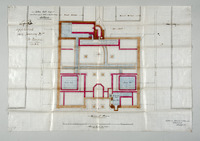 Bath and Wash House, Saltaire, West Yorkshire, United Kingdom Titus Salt built the Bath and Wash houses in 1863 at a cost of £7000 (over £600,000 today). These housed 24 baths, 12 each for men and women and a Turkish bath. A warm bath would cost 6d. and a cold one 3d. The wash house contained everything people would need to wash and dry their clothes: 48 washing, rinsing and steam tubs, 48 drying closets, a steam dryer and mangles, meaning clothes could be cleaned and dried in under 1 hour. As in the rest of the North of England, the Bath and Wash Houses did not prove popular. People preferred to bathe in the privacy of their own homes and wash clothes in their own kitchen where they could also complete other tasks. The buildings were converted into houses in the late 1800s before being completely demolished in 1936. Today, a community garden has been planted on the site, following consultation with residents in 2011.
 -
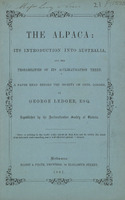 F1a-191: 'The Alpaca - Its Introduction to Australia A paper read before the Society of Arts London by George Ledger. George Ledger was the brother of Charles Ledger the main importer of alpacas from Peru. The paper outlines the story of Titus Salt's involvement with the early production.
 -
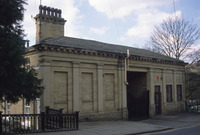 Stables building, Saltaire, West Yorkshire, United Kingdom Originally the stables for Salts Mill. Now converted to residences.
 -
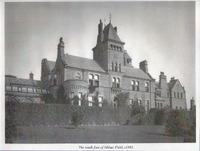 Milner Field, Bingley, West Yorkshire, United Kingdom Milner Field was a neo-gothic mansion built for Titus Salt Junior and Catherine Salt. They purchased Milner Field Estate on the ourskirts of Bingley in 1869. An existing manor house and farm were demolished and replaced with a new house, completed in 1871, and a new model farm. At Milner Field, the Salts hosted the Prince and Princess of Wales in 1882 when they were visting Bradford. In 1887 Princess Beatrice and her husband also stayed at the house while visting to open the new School of Art and Science in Saltaire.
 -
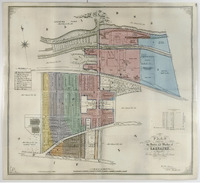 Saltaire, West Yorkshire, United Kingdom Saltaire is an area on the Western edge of Shipley in West Yorkshire. The village was created from the 1850s onwards by Bradford industrialist Titus Salt as a location for a new textile mill and homes and amenities for its workers. The village had many public buildings and amenities including: shops, schools, a dining hall, a Club and Institute, and a public park with sporting areas. Most of the village remains intact today. In 2001 Saltaire became a UNESCO World Heritage Site.
 -
 Bradford, West Yorkshire, United Kingdom A large cathedral city in West Yorkshire. During the Industrial Revolution Bradford became a major centre for woollen textile production and rapidly grew in size. Titus Salt's original textile business was based in Bradford. By the 1850s the growth in size had resulted in insanitary, poor living conditions for many workers. This prompted Titus Salt to create Saltaire as a model village for his mill and its workers.
 -
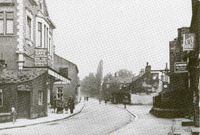 Baildon, West Yorkshire, United Kingdom Baildon is a town near to Saltaire in West Yorkshire. Baildon adjoins Saltaire and Shipley to the north, about 3 miles from Bradford. The Salt and Roberts families owned land and properties in Baildon.
 -
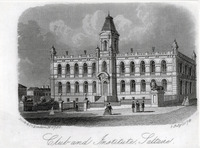 Victoria Hall, Saltaire, West Yorkshire, United Kingdom Originally, this building was known as The Saltaire Club and Institute, with only the main hall called Victoria Hall. Completed in 1871, it was one of the final pieces of Titus Salt’s vision of a model village, providing everything a person needs in life. The institute was intended, first and foremost, to provide a social gathering space for residents (rather than a pub) and, secondly, as an educational institute. The building housed rooms for billiards, bagatelle, chess and drafts, reading, classrooms, a library, a laboratory and a large hall for lectures and concerts. It also housed the Schools of Art and Science, which later moved to the Exhibition Building. Today, the building is managed by the Salt Foundation and provides a venue for community events and weddings.
Catalogue data (excluding media) available under Creative Commons Attribution-ShareAlike (CC BY-SA 4.0) licence.
321–340 of 5131