
Brook Collection
Item set
- Type
- collection
- Identifier
- COL80
- Title
- Brook Collection
- Description
- Items donated by local historian Les Brook
Items
-
 2020.21: Sir William Fairbairn A portrait drawing of Sir William Fairbairn, the leading Victorian engineer, published in the Supplement to the Illustrated London News 29 August 1974 following his death.Farirbairn helped to design Salts Mill
 -
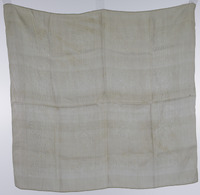 2021.2: Silk scarf Silk scarf printed with 'Yorkshire Royal Exhibition 1887 plus the Salt coat of arms. See also 2022.1 for a similar item.
 -
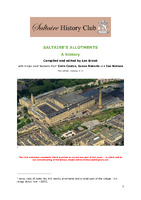 2022.74: Saltaire's Allotments: A history A history of the various allotments in Saltaire researched by Les Brook with major contributions from Colin Coates and James Roberts. A detailed history of the provision and use of allotments in Saltaire, including many changes to their extent and location.
 -
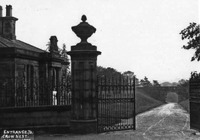 2024.133: Crow Nest entrance gate A photograph of the entrance to Crow Nest, a favoured home of Sir Titus Salt. One side of the entrance lodge is visible next to an open metal gate and a roadway beyond.
 -
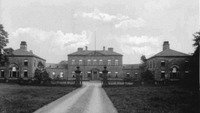 2024.134: Frontal view of Crow Nest house A photograph of the full front of Crow Nest, a favoured home of Sir Titus Salt. There is a large central part to the house and two wings.
 -
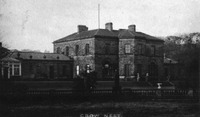 2024.135: Rear view of Crow Nest house A photograph of the rear of the central part of Crow Nest, a favoured home of Sir Titus Salt. The photograph shows the central part of the building with a garden and fencing in front.
 -
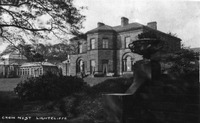 2024.136: Rear view of Crow Nest house A photograph of the rear of the central part of Crow Nest, a favoured home of Sir Titus Salt. The photograph shows the central part of the building with a garden in front. A large glass-fronted conservatory is visible on the left.
 -
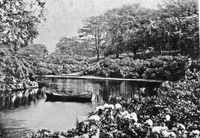 2024.137: Crow Nest lake A photograph of the small lake at Crow Nest, a favoured home of Sir Titus Salt. A rowing boat is visible on the lake. The lake is surrounded by plants and trees.
 -
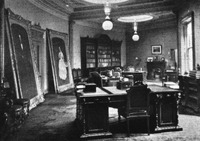 2024.138: Crow Nest room with desk A photograph of a large room in Crow Nest, a favoured home of Sir Titus Salt. A large, ornate desk is in the foreground. Two large portraits, restiing on the floor, are on the left wall. A large bookshelf is visible in the rear.
 -
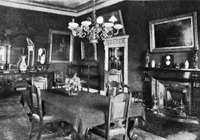 2024.139: Crow Nest dining room A photograph of a large room in Crow Nest, a favoured home of Sir Titus Salt. A large dining table with chairs is the main part of the picture. A fireplace is on the right, and paintings and a mirror are visible on the walls.
 -
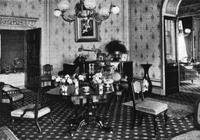 2024.140: Crow Nest room A photograph of a room in Crow Nest, a favoured home of Sir Titus Salt. An oval table with flowers in jars is in the centre of the photograph. Open interior doors on the left and right show other rooms.
 -
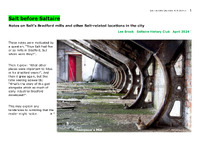 2024.33: Salt before Saltaire A research document from local historian Les Brook on the history of Sir Titus Salt before the move of his business to Saltaire in 1853. In four parts: Part 1: The investigation starts with snippets of evidence […in Part 2 onwards, I try to make sense of these] 3 Part 2: The Salts’ Early Years in Bradford 12 Part 3: Titus Salt’s Bradford mills 16 Part 4: A Cartographic Summary of Titus Salt’s Bradford before Saltaire
 -
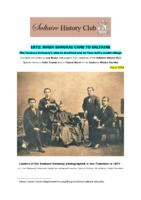 2024.34: 1872: When samurai came to Saltaire A research document from local historian Les Brook on the visit in 1872 of the Japanese Iwakura Embassy visit to Saltaire. The Iwakura Embassy was a high-level governmental group from Japan who toured the world to investigate the latest developments in industry and technology. They visited Saltaire to view the renowned Salts Mill and the model village of Saltaire. Contents include: What was the Iwakura Embassy? The Embassy’s historical backstory The members of the Embassy The Embassy in the USA Four months in Britain The visit to Bradford and Saltaire DAY 1: Thursday 24 October 1872 DAY 2: Friday 25 October 1872 DAY 3: Saturday 26 October 1872 DAY 4: Sunday 27 October 1872 DAY 5: Monday 28 October 1872 From Yorkshire to London The Embassy in continental Europe, and beyond
 -
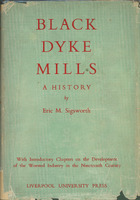 2025.1: Black Dyke Mills: A history A history of the textile industry of Messrs John Foster and Son Limited at Black Dyke Mills in Queensbury, near Bradford. There are introductory chapters on the development of the worsted industry in the nineteenth century. Contains many references to Titus Salt. There is a chapter on 'The trade in alpaca and mohair' that contains information on the competition ánd collaoration with Titus salt on the importation and use of alpaca wool. Contains maps of the Black Dykes Mills complex from 1854 and 1881. There is a single page letter enclosed in the book presenting it from the company of John Foster & Son Limited to 'Mr Hibbert'.
 -
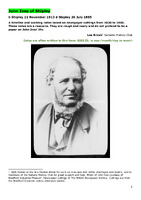 2026.1: John Ives timeline and notes A 78 page document with notes, newspaper exceprts and some excerpts from plans and maps all relating to the life and activities of John Ives. John Ives was a major builder during the mid to late nineteenth century in Bradford and surrounding areas. He built Bradford's new town hall, and many buildings in Saltaire.
 -
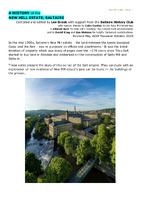 2026.2: A history of the New Mill Estate, Saltaire A 71 page document with notes, photographs and some excerpts from plans and maps all relating to New Mill. part of the Salts Mill complex. The document covers the history of the site fom the seventeenth century to the early twenty first centiury, including: - Dixon Mill, a corn and fulling mill built in 1635, occupied the site where New Mill was later constructed. - As part of the building of the original Salts Mill, a gas works on teh same site was proposed in 1852, serving both the mill and the village. - The Mill was expanded in 1868 by builkding New Mill, with a notable campanile chimney. - The estate experienced significant events such as a major fire in 1881 and a breach in the weir in 1884, causing mill shutdowns. - By the late 19th and early 20th centuries, the estate saw further extensions, infrastructure improvements, and the introduction of electric power. - In the mid-1990s, the estate was repurposed for offices and apartments, with remnants of its industrial past still visible today.
 -
 2026.3: Saltaire: the making of a model town A critical appraisal of the analysis of the 16 building contracts A 20 page document with text and images of newspaper cuttings. This document critically analyzes the historical building contracts and tender processes involved in the development of Saltaire village, as detailed in Jackson, Lintonbon and Staples' book 'Saltaire: the making of a model town'. A particular issue addressed is that the term 'building contract' is used, both historically and by the book authors, to refer to a range of items, including invitations to tender as well as actual contracts. Another problem considered is that often contracts were advertised for both public buildings and housing but then subsequently separated.
 -
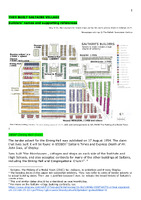 2026.4: They built Saltaire An 8 page document with a plan of the village of Saltaire indicating the parts that were constructed by different builders. The document outlines the key builders and contractors involved in the development of Saltaire village, highlighting their roles, projects, and historical context. A major builder was John Ives, but the document also details others including: Molson, Ingram Lapish, and John Barry. A particular issue addressed is that the term 'building contract' is used, both historically and by the book authors, to refer to a range of items, including invitations to tender as well as actual contracts. Another problem considered is that often contracts were advertised for both public buildings and housing but then subsequently separated.
 -
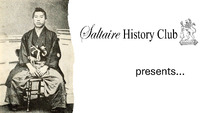 2026.5: 1872 When samurai came to Saltaire A PowerPoint presentation of 46 slides used to support a talk given by local historian Les Brook to the Saltaire History Club about the visit to Saltaire in 1872 by the Iwakura Embassy. The Iwakura Embassy was a global mission by high-ranking officials from Japan to industrialised countries to obtain information helpful in the modernisation of Japan. The talk deals with the background of the mission and then describes their visit to Britain, including Bradford and the surrounding distict in late October 1872. They came to Saltaire on 25 October and the talk describes their being met by Titus Salt Junior and company director Charles Stead, and their tour of the village including the High School, primary school, almshouses, and park.
Catalogue data (excluding media) available under Creative Commons Attribution-ShareAlike (CC BY-SA 4.0) licence.
1–19 of 19