
Items
Search full-text
https://www.galaxus.ch/en/sector/showdiscussion/hacked-snap-visit-kunghaccom-8t1e41z7-223015
-
 West Riding County Council The council was the county-level administrative body that contained Shipley and Saltaire. It was abolished in 1974 as part of the local government reorganisation. Much of its responsibilities passed to the new West Yorkshire County Council which functioned until 1986.
 -
 Roberts, James Denby Son of Bertram Foster Robert, grandson of Sir James Roberts
 -
Anne, Princess Only daughter of Queen Elizabeth II of the United Kingdom
-
Foster, Walter Christopher Early twentieth century artist. Born in Bingley, West Yorkshire
-
J. Parkinson and Son Limited Joseph Parkinson founded his engineering company in 1865. The business specialised in making machinery for the booming textile industry.
-
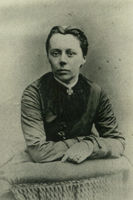 Griffiths, Medina Medina Griffiths (1840–1927) was an outstanding and progressive educator who served as the first headmistress of the Salt Girls' High School in Saltaire. Appointed in 1876, she was known for her 'outstanding character and ability' and her commitment to providing girls with an education equal to that of boys. Early Life and Background Born in Wales in 1840, Medina was the daughter of a Congregational minister. Before moving to Saltaire, she taught at a school near Cardiff. Leadership at Salt Girls' High School Medina Griffiths led the school during its formative years: - Establishment: The girls' school opened in 1876, initially sharing a building on Victoria Road with the Factory School before the younger children moved to a new site on Albert Road in 1878. - Broad Curriculum: She introduced a wide range of subjects, including Latin, Greek, French, mathematics, drama, art, and music. - University Aspirations: She actively encouraged her students to remain in education and pursue university degrees, which many did. - Succession: She remained headmistress until 1886, when she was succeeded by Harriet Byles, who had previously taught under her. Educational Philosophy and Teaching Style Griffiths was considered an inspirational and enlightened teacher with several unique approaches to education and discipline: - Equality for Girls: She famously stated, 'I would have girls placed on an equality with boys so far as educational advantages are concerned…I would have girls stand in the foremost rank'. - Holistic Learning: She believed lessons in 'patience, unselfishness, self-control and attention to detail' could be learned as effectively through well-directed plays as through traditional schoolwork. - Approach to Discipline: She set a rule that girls should have no more than one hour of homework per day, believing that five hours of work during the school day was sufficient. - Student Relationships: She was known to be witty and musical, often reading to students during mealtimes. On her birthdays, she entertained students at her home, where each girl brought a gift of toys or clothing to be donated to charity. The Saltaire Collection preserves records of her tenure, including school certificates bearing her signature and that of Titus Salt Junior.
 -
Salt, Fanny Second daughter of Sir Titus and Caroline Salt. She died of tuberculosis just days before her twentieth birthday.
-
Salt, Mary Third daughter of Sir Titus and Caroline Salt. She died in infancy of 'congestion of the brain'.
-
Sharp, Dorothy Over 6,000 Items make up the Saltaire Collection today and it all started with one person, Dorothy Sharp. Dorothy came to Saltaire in 1984 and was employed temporarily at Shipley Library, then located in Victoria Hall. Her first job was to sift through the local history collection to find materials suitable for schoolchildren. Later in 1984 Dorothy moved to nearby Shipley College as an assistant librarian and developed her interest in Saltaire's history. In 1987/88 Dorothy helped set up the 'Saltaire Resouce Base' - to support visiting schools - in the reopened Salts Mill, now a business, leisure and art centre being developed by local entrepreneur Jonathan Silver. Dorothy became known locally as someone who was interested in collecting and preserving materials to do with Saltaire. And so the donations came in, and the Saltaire Collection (as it is called now) was born and began to grow!
-
 Ossett, West Yorkshire, United Kingdom Ossett is a market town near to Wakefield in West Yorkshire
 -
Strathallan Castle, Perthshire, United Kingdom Strahallan Castle was purchased by Sir James Roberts in 1910. Sir James offered the castle for use during the First World War, and it was used a a Red Cross convalescent hospital. Durng the Second World War it temporarily hosted a Glasgow girls school that had been moved for safety. Today the castle is still home to some of Sir James's descendants.
-
Sayner, Ruby Born in 1897, Ruby was one of nine children living in Titus Street, Saltaire. She left school at thirteen to work at Henry Mason’s Mill in Shipley. During the First World War she was one of only two people from Shipley to join the Women’s Land Army. She trained at Esholt Hall before working on farms nationwide to support Britain’s food supply. She served again in the Second World War, working night shifts as an A.R.P. Warden before returning to her job as a weft clerk. Ruby’s passion for cricket saw her playing for Saltaire and Blythwick Ladies. She was coached by England bowler Sidney Barnes and represented Yorkshire at Headingley and Bradford Park Avenue.
-
Muschamp, Ivy Born in 1918, Ivy was the youngest of four children. She attended Salts Girls’ High School and later became an invoice clerk for a local gown manufacturer, also volunteering as a factory first aider. Ivy went on to run a grocer’s shop with her husband on Victoria Road, Saltaire, while raising four children. Ivy was an active member of Bethel Baptist Church - performing in, organising and hosting groups. In 1957 she offered accommodation to a member of the Jamaican delegation visiting the World Scout Jamboree. Ivy’s story, like that of many women, is a quiet one but shows how her commitment to helping others plays an important part of community life.
-
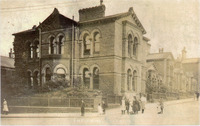 Mitchell, Hannah Hannah Mitchell was appointed Matron of Sir Titus Salt’s Hospital in 1899. She had trained at Kings College Hospital, London and worked at Bradford Royal Infirmary. Her 'job description' covered not just medical matters but all aspects of the hospital’s operation and management including fund raising. Hannah was an extremely competent, ambitious and progressive woman, a strong advocate of women’s rights as evidenced by her numerous letters in the local press. She was a committed Catholic and for many years, president of the local branch of the Catholic Women’s League. During World War One the hospital was designated a War Hospital. Hannah was extremely popular with the convalescent soldiers, raising money and organising activities for their entertainment. As with all women at that time, on her marriage in 1918 Hannah had to leave her job. Having stated she didn’t want any gifts the soldiers clubbed together and bought her a case of silver spoons. She died in 1936. In her will she left £10 (approximately £900 today) to the hospital
 -
 2026.4: They built Saltaire An 8 page document with a plan of the village of Saltaire indicating the parts that were constructed by different builders. The document outlines the key builders and contractors involved in the development of Saltaire village, highlighting their roles, projects, and historical context. A major builder was John Ives, but the document also details others including: Molson, Ingram Lapish, and John Barry. A particular issue addressed is that the term 'building contract' is used, both historically and by the book authors, to refer to a range of items, including invitations to tender as well as actual contracts. Another problem considered is that often contracts were advertised for both public buildings and housing but then subsequently separated.
 -
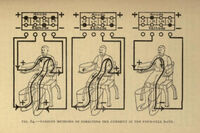 Magill, Ethel Ethel May Magill was a pioneering British physician and radiologist who graduated from the London Medical School for Women in 1906. During World War I, she served as a consultant radiologist at Endell Street Military Hospital, where she specialized in locating shrapnel and developing early physiotherapy techniques. Magill authored an influential textbook on electrotherapy and received an OBE in 1920 for her wartime service. Her career spanned clinical work in North America and Africa before she retired to Kent. She remained an active member of the medical community until her death in 1970.
 -
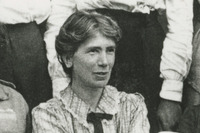 Lund, Annie Possibly the most significant event in Annie Lund’s life was the death of her father, a farmer in Brafferton, North Yorkshire, in a shooting accident in 1879 when she was five. This sudden bereavement brought the Lund family of at least seven children to Manningham in Bradford. Annie was the youngest daughter but one. In 1886 she was sent to the Salt High School for Girls, a fee-paying school. She moved from being a pupil to being a teacher in 1893. It was a solid career with a salary starting at £90 a year rising by many increments to £315 a year. in 1921, amply repaying the money her family spent on her education. She retired in 1933 and died in 1950, leaving £7,800 (about £240,000 in 2026)
 -
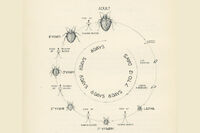 Hunter, Laura Born in Baildon in 1897, Laura Thorpe studied at Salt Girls’ High School before graduating from Liverpool University. She lectured in both Zoology and Biology at the University of North Wales, Bangor and later at the Leicester College of Domestic Science. After gaining the Annie Edison Memorial Scholarship Laura wrote Domestic Pests: What They Are, How To Remove Them, a manual that appealed to both housewives and scientists by offering solutions to everyday problems such as how to get rid of insects, rodents and mould. During the Second World War she focused on public health and nutrition. Her clear, practical advice remains relevant today.
 -
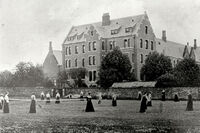 Walker, Sarah Anne Sarah’s career began at Salts Girls High School, where she was both a pupil and a teacher. Her academic success led to a scholarship at the Maria Grey Training College followed by a distinguished career at Southlands College, becoming Vice Principal. Sarah later went on to become Principal of Darlington Training College championing Frobelian and Montessori teaching. She opended one of the first open air nursery schools in the country. Sarah advocated improved teacher training, nursery education and the advancement of women both through her work and membership of local and national organisations. Her legacy continues today via student scholarships and grants.
 -
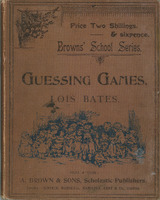 Bates, Lois Lois Bates grew up in a large family in Almondbury, Huddersfield, before beginning a career that would shape early years education in Saltaire and beyond. In 1879 she was appointed Mistress of Albert Road Infant School, remaining there for more than fifteen years. Her influential books - 'Saltaire Action Songs' and 'Guessing Games' - helped popularise her Froebelian education methods, many of which were adopted by the Education Department. Children under seven experienced a less formal style of teaching, learning social skills and manners through stories, songs and play. Although she had to give up her teaching career when she married in 1895 , Lois continued to write, producing further works including her 'Kindergarten Guide', now recognised as an important contribution in the history of early-years education.
Catalogue data (excluding media) available under Creative Commons Attribution-ShareAlike (CC BY-SA 4.0) licence.
321–340 of 460