
Items
Search full-text
dining hall
-
 D2-029: Leisure - Sports & Social Clubs Collage of 3 photos of Salt Gymnastic members including Florence Mason (nee Booth)
 -
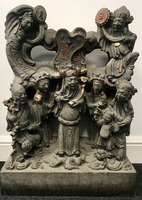 D3-117: Chinese Sculpture Chinese stone sculpture found during the excavations prior to building the greenhouses for Shipley College Gardens and horticulture students. It is believed that the sculpture was part of a Japanese Village which was part of the in the 1887 Royal Yorkshire Jubilee Exhibition. It is a Taoist scuplture depicting several deities, accourding to a letter from the Deputy Keeper of Ceramics in the Victoria and Albert Museum in 1968. From the left the deities are the Ch'ang the Moon Queen, Ch'ih-chang the Sun King, Shou Lau the God of Longevity with his deer and the central figure is Fu Hsing or Lu Hsingthe God of happiness or weath.
 -
D4-026: Children and teachers in the Congregational Sunday School Photocopy of photograph of children and teachers in the main hall of the Congregational Sunday School. Young children are mainly seated at the fron of the picture. Adults stand behind the children and also on a raised platform. Older children and more adults are visible on a balcony at the back.
-
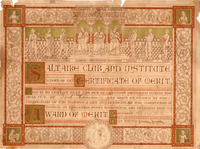 H1-054a: Certificate of Merit for Fred Hanson Saltaire Club & Institute, School of Art: Certificate of Merit awarded to Fred Hanson (Donald Hanson's grandfather) On the back are 3 documents - photo pf Great uncle James and Cousin Percy; card 'In Remembrance'; Notice of memorial service for Percival Hanson Jenkins 1890-1966
 -
 H2-196a-b: Sir James & Lady Roberts Painting of Sir James & Lady Roberts at 'Fairlight' 1923
 -
 A1-106: Mrs Titus Salt's Visitors Book & Dinner Guests 1887-1904 A small notebook with lined paper containing Catherine Salt's handwritten lists and comments. Catherine used this book to help plan social gatherings such as garden parties, formal dinners and parties, including the 'coming out' party of her daughter Isabel. Catherine Salt became a widow in late 1887 so most of the events occur when she was the sole head of the household at Milner Field and for the last two years at Denton Hall in Ilkley. The book contains such things as: - lists of invitees to the events (but not who actually attended). - arrangements of items for parties and the rooms in her house Milner Field where the items were to be located - required items and services from commercial suppliers and trades people - comments on the aftermath of the events, including notes on damages sustained and things that had gone wrong The notebook was used from both ends at the same time, with the book flipped over. Further research is required to understand why there are two different uses. Note that a small number of pages are blank. There are also several loose pages that have been placed in the notebook, apparently with the same type of details as the notebook: 1. A single page listing items and their costs for an event in 1896 2. A double-sided singel sheet with a list of people for an event on 'May 20'. Some entries have ticks against them. 3. A double-sided single sheet for a 'Dance' on May 7 1892. Seems to contain items required fore the dance 4. Four pages mainly containing names of people who had accepted or declined attendance at an event. Also some notes.
 -
 Ilkley, West Yorkshire, United Kingdom Ilkley is a market town north of Saltaire, Shipley and Baildon in North Yorkshire. Ilkley was the location of Denton Hall, a large house in its own grounds that was the home of Catherine and Isabel Salt after they moved from Milner Field in Bingley in the early twentieth century.
 -
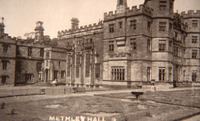 Methley, West Yorkshire, United Kingdom A viilage near Leeds in West Yorkshire. Titus Salt rented Methley Park as his main home between 1858 and 1867.
 -
 Sharp, Dorothy Over 7,000 Items make up the Saltaire Collection today and it all started with one person, Dorothy Sharp. Dorothy came to Saltaire in 1984 and was employed temporarily at Shipley Library, then located in Victoria Hall. Her first job was to sift through the local history collection to find materials suitable for schoolchildren. Later in 1984 Dorothy moved to nearby Shipley College as an assistant librarian and developed her interest in Saltaire's history. In 1987/88 Dorothy helped set up the 'Saltaire Resouce Base' - to support visiting schools - in the reopened Salts Mill, now a business, leisure and art centre being developed by local entrepreneur Jonathan Silver. Dorothy became known locally as someone who was interested in collecting and preserving materials to do with Saltaire. And so the donations came in, and the Saltaire Collection (as it is called now) was born and began to grow!
 -
Wilson, Samuel Samuel Wilson was Titus Salt's Chief Cashier. He spoke at the major occasion in St George's Hall, Bradford in 1865, when Sir Titus was presented with the famous bust which now stands in the entrance of Saltaire United Reformed Church.
-
Lockwood, Henry Francis Influential British architect. In 1849 he formed a highly successful partnership with William Mawson. They designed major buildings in Bradford, including St George's Hall and the Wool Exchange. Sir Titus Salt engaged them to desgn his new Salts Milll and its surrounding village of Saltaire, including its many publoic buildings.
-
 Woods, Clive Clive Woods gave up his life as a teacher and moved to Saltaire in 1986 to continue his researches on Titus Salt and his model village. He opened a bookshop, worked for a while as a caretaker at Victoria Hall, and became a well-known guide, leading tours around Saltaire. Clive helped found the Village Society and became a vigorous campaigner to preserve Saltaire and its heritage. In the late 1980s he was part of the successful campaign against plans to build a major trunk road through Saltaire. He also worked to get Saltaire listed by English Heritage, work that helped prevent the village from being recklessly changed. In the late 1990s he became a leader of the campaign, supported by the local MP and Bradford Council, to have Saltaire recognised by UNESCO as a World Heritage Site. This was awarded in 2001, a success widely hailed as the most important for Saltaire since its foundation 150 years before. Sadly, Clive died in 2007 but his legacy is a Saltaire preserved for the future. The Saltaire Collection is proud to host his archive of research documents, books, leaflets and photographs.
 -
Ives, John John Ives was a joiner, builder, and contractor involved in major projects including Salts Mill, Saltaire housing, and public buildings: - Contracted for masonry, joinery, ironwork, roofing, and slating for Salts Mill in 1852. - Acted as joinery contractor for Salts Mill - Built the first houses and shops in Saltaire around 1853 - Awarded contracts for 80 houses in Saltaire in 1866, including Albert Rd, Shirley St, Katherine St, and Myrtle Place. - Built Saltaire Church (1859), Saltaire School, and other community structures. - Partnered with Benjamin Lapish in the firm Lapish & Ives, securing numerous building contracts. - Built houses on Saltaire Road and Windhill Church, with ongoing collaborations with architects Lockwood and Mawson. - Constructed almshouses, dispensary, and other public buildings, often under competitive tenders. Ives also built many other buildings in the Bradford area, most notably Bradford's large Town Hall designed by Saltaire's architects Lockwood and Mawson. Ives was also a prominent musician and leader of a local choral society in Shipley.
Catalogue data (excluding media) available under Creative Commons Attribution-ShareAlike (CC BY-SA 4.0) licence.
481–493 of 493