
Items
Search full-text
roberts park
-
 2024.10: Sir James Roberts leaves Saltaire (The land disposals of Sir James Roberts) Document describing the land holdings of Sir James Roberts in Saltaire and nearby Milner Field following his sale of the Salts textile business in 1918. The research is based mainly on letters exchanged between Sir James Roberts and his representative in Saltaire, John Baker.
 -
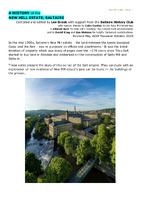 2026.2: A history of the New Mill Estate, Saltaire A 71 page document with notes, photographs and some excerpts from plans and maps all relating to New Mill. part of the Salts Mill complex. The document covers the history of the site fom the seventeenth century to the early twenty first centiury, including: - Dixon Mill, a corn and fulling mill built in 1635, occupied the site where New Mill was later constructed. - As part of the building of the original Salts Mill, a gas works on teh same site was proposed in 1852, serving both the mill and the village. - The Mill was expanded in 1868 by builkding New Mill, with a notable campanile chimney. - The estate experienced significant events such as a major fire in 1881 and a breach in the weir in 1884, causing mill shutdowns. - By the late 19th and early 20th centuries, the estate saw further extensions, infrastructure improvements, and the introduction of electric power. - In the mid-1990s, the estate was repurposed for offices and apartments, with remnants of its industrial past still visible today.
 -
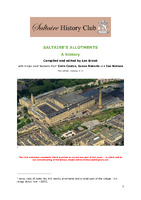 2022.74: Saltaire's Allotments: A history A history of the various allotments in Saltaire researched by Les Brook with major contributions from Colin Coates and James Roberts. A detailed history of the provision and use of allotments in Saltaire, including many changes to their extent and location.
 -
 2024.36: Descriptive Index Catalogue of the Library of the Saltaire Club and Institute A full catalogue of the contents of the Library of the Saltaire Club and Institute. Has brief details in the front of the volume of the operation of the LIbrary. Most of the 1665 pages consist of an alphabetical listing of the items held in the Library.
 -
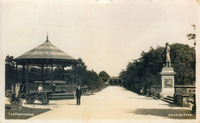 Roberts Park, Saltaire, West Yorkshire, United Kingdom Originally named Saltaire Park, the 14 acre space opened in 1871 and was free for anyone to enjoy. However, there were strict rules enforced in the park. Among other things, political and religious demonstrations were banned, as were wheeled vehicles and unaccompanied children under 8. By the early twentieth century Salts Mill and Saltaire were owned by Sir James Roberts, Roberts retired in 1918 and in 1920 gifted the park to Bradford Corporation for public use. At the same time, the part was renamed Roberts Park in memory of James's deceased son, Bertram Foster Roberts.. The park was originally reached by a bridge from the end of Victoria Road, over the valley to what is now the West entrance, at the lodge. This bridge had to be demolished after World War II, due to damage caused by tanks crossing to use the area for manoeuvres.
 -
 C3b-272a-b: The Land Acquisitions of Titus Salt in Shipley & Baildon 2 copies of booklet: 'The Land Acquisitions of Titus Salt in Shipley & Baildon' by Ian Watson
 -
 Roberts, James, Sir Sir James Roberts was a prominent industrialist and philanthropist who is widely credited with 'saving Saltaire' and preserving its industrial heritage after the Salt family business faced financial collapse in the early 1890s. He rose from humble origins to become the sole owner of Salts Mill and the Saltaire estate, shepherding the village through the challenges of the early 20th century. Early Life and Business Rise Born in Oakworth to a weaver, Roberts came from a family with few resources. Neither of his parents were literate. He began working part-time in a spinning mill at age 11. Roberts eventually became a successful wool merchant. He gained a significant competitive advantage through his extensive knowledge of and frequent travels to Russia to source merino wool, eventually becoming fluent in the Russian language. Ownership and Management of Saltaire In 1893, after the Salt family business entered voluntary administration, Roberts joined a four-man consortium to purchase the mill and the village. By 1902, he became the sole owner of Salts Mill and the Saltaire estate. Under his leadership, the business returned to high profitability. He oversaw a major extension of Salts Mill, increasing its size by approximately one-third through the addition of a new spinning block and dyeing areas. In 1903, he purchased the **Milner Field** estate, the former home of Titus Salt Junior, from Salt's widow, Catherine. Preserving Salt’s Legacy and Philanthropy Roberts maintained Sir Titus Salt’s principles, sustaining annual payments to Salt’s charities and never changing the name of the business from 'Sir Titus Salt Bart. and Sons Co. Ltd.'. In 1903, to celebrate Saltaire's 50th anniversary, he commissioned the statue of Sir Titus Salt that still stands in the village park. In 1920, he gifted the village park to the Bradford Council for public use, requesting it be renamed Roberts Park in memory of his late son, Bertram. He purchased the Brontë Parsonage in Haworth for the Brontë Society in 1928 to serve as a museum. He also gifted £10,000 to the University of Leeds to create a professorship in Russian language and literature. Public Service and Recognition Roberts served on the Shipley Urban District Council and the West Riding County Council, and was a Justice of the Peace for West Yorkshire. He was also a governor for the Salt Schools. In 1909, he was awarded a baronetcy, becoming Sir James Roberts, First Baronet of Milner Field. To celebrate, he gave his workers a week of paid holiday and established a pension scheme for those over 65. Personal Tragedies and Sale of the Estate Roberts’ tenure of Saltaire was marked by significant personal loss as three of his four sons died prematurely: - His eldest son, Willy, died of tuberculosis in 1898. - His youngest, John Edward, drowned in Ireland in 1904. - His son Bertram, who was being groomed to take over the business, died in 1912. - His remaining son, Harry, was so seriously injured in World War I that he could not continue in the business. Due to these tragedies and his own declining health, Roberts sold the mill and the village in 1918 to a new syndicate. Upon the sale, he gave generous gifts to his employees totaling approximately £20,000 to £30,000. He died in 1935 at the age of 87.
 -
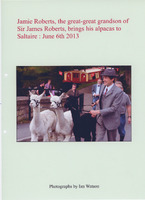 C2b-240: Jamie Roberts visit with alpacas Album of photographs of Jamie Roberts' visit to Saltaire with his alpacas on 6th August 2013. Jamie Roberts is a decendant of Sir James Roberts
 -
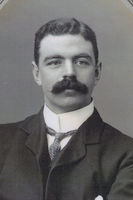 Roberts, Bertram Foster Bertram Foster Roberts was the second son of industrialist Sir James Roberts. He was actively groomed to succeed his father in managing Salts Mill and the Saltaire estate, but his promising career was tragically cut short by his premature death at the age of 36. Bertram was appointed a company director of Sir Titus Salt Bart. and Sons Co. Ltd. in July 1898, following a reorganization of the firm's board. In 1902, when his father became the sole proprietor, Bertram and his mother Elizabeth joined Sir James as the exclusive owners and managers of Salts Mill and the Saltaire estate. As his father aged, Bertram took on increasingly significant responsibilities for the day-to-day operations of the mill, and was positioned to lead the business into the next generation. Berrtram played an exceptionally prominent role in the civic, educational, and political life of the local community. He served as the President of the Shipley Board of Health. He sat on the Shipley Education Committee and was a governor for both the **Salt Schools** and the Bradford Royal Infirmary. In 1903, Bertram married Eliza Gertrude Denby, the only daughter of Ellis Denby, a prominent local figure from Shipley. In 1910, Bertram began suffering from severe back pain and was diagnosed with 'serous neuritis'. He suffered a complete physical breakdown in November 1911 and passed away shortly after, on January 11, 1912, at the age of 36. He was buried in a local cemetery alongside his older brother Willy, who had died of tuberculosis in 1898. Bertram's death was a massive blow to his father, who lost three of his four sons to early deaths. In 1920, Sir James Roberts gifted Saltaire's 14-acre public park to the Bradford Council to hold in trust for the community. As his only request for this grand donation, Sir James asked that the park be renamed Roberts Park in memory of Bertram. A commemorative plaque honouring Bertram still stands in the park today.
 -
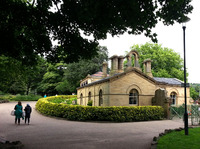 2025.68.67: Building on Loverose Way (Roberts Park) The building on Loverose Way in Roberts Park, next to the skate park.
 -
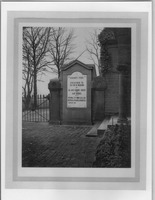 H2-116: Commemoration plaque for Roberts Park Photograph of the plaque on the presenting of Saltaire Park to the Borough of Bradford by James Roberts. The plaque commemorates Sir James's son Bertram Foster Roberts who had died in 1912.
 -
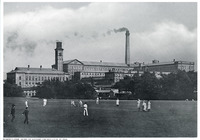 2024.31.5: Roberts Park, home of Saltaire Cricket Club in 1916 Roberts Park, home of Saltaire Cricket Club in 1916 1 of a set of 12 photographs from the collections of the Saltaire Village Society and the Saltaire Traders' Association
 -
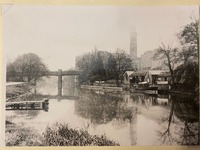 C2b-032: Saltaire Images of Places Collection of 26 photographs and postcards relating to Saltaire.Subjects include: Saltaire Picture House, Roberts Park, trams, various leisure activities.
 -
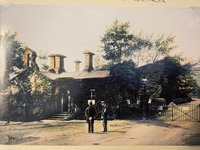 C2b-032.4: Roberts Park lodge house Photograph of Roberts Park lodge house, Saltaire. Shows gates to Coach Road on right.Two men stand in front of the lodge.
 -
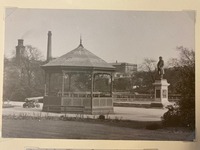 C2b-032.13: Bandstand in Roberts Park in Slataire Postcard showing the bandstand, canons and statue of Sir Titus Salt in Roberts Park.
 -
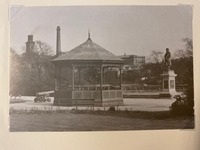 C2b-032.15: Bandstand in Roberts Park, Saltaire Postcard showing the bandstand, canons and statue of Sir Titus Salt in Roberts Park.
 -
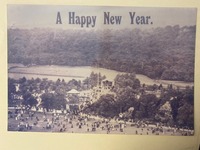 C2b-032.22: Roberts Park, Saltaire Photograph showing lots of people in Roberts Park, with 'A Happy New Year' printed above.
 -
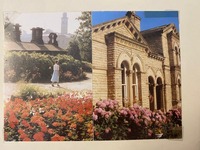 C2b-032.26: Lodge house in Roberts Park, and an almshouse in Saltaire Postcard showing two colour photographs. One is the lodge house in Roberts Park and the other is one of the almshouses in Alexandra Square. Both photos are showing the large hydrangeas in bloom.
 -
 D3-083: Roberts Park promenade Photograph of Roberts Park. Shows the main promenade with children on the canon by the bandstand.
 -
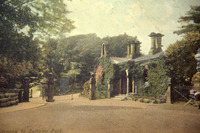 C2b-102/11/16: Rose cottage Roberts park (122) Rose cottage Roberts park (122). One of a collection of Slides relating to Saltaire compiled by Albert Bowtell.
Catalogue data (excluding media) available under Creative Commons Attribution-ShareAlike (CC BY-SA 4.0) licence.
1–20 of 902