
Items
Search full-text
salts mill
-
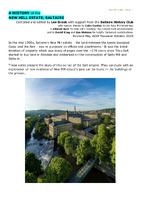 2026.2: A history of the New Mill Estate, Saltaire A 71 page document with notes, photographs and some excerpts from plans and maps all relating to New Mill. part of the Salts Mill complex. The document covers the history of the site fom the seventeenth century to the early twenty first centiury, including: - Dixon Mill, a corn and fulling mill built in 1635, occupied the site where New Mill was later constructed.? - As part of the building of the original Salts Mill, a gas works on teh same site was proposed in 1852, serving both the mill and the village. - The Mill was expanded in 1868 by builkding New Mill, with a notable campanile chimney. - The estate experienced significant events such as a major fire in 1881 and a breach in the weir in 1884, causing mill shutdowns. - ?By the late 19th and early 20th centuries, the estate saw further extensions, infrastructure improvements, and the introduction of electric power. - In the mid-1990s, the estate was repurposed for offices and apartments, with remnants of its industrial past still visible today.
 -
 2022.51: The history of Pace The story of Pace Microtechnology from its foundation in the early 1980s to its acqusition by Arris in the 2010s. Based on original research by Mike Farren, including extensive interviews with the founders David Hood and Barry Rubery and key manager Rob Fleming.
 -
 2020.6.2: Saltaire Overlookers 1830-1914 'Saltaire Overlookers 1830-1914' by Roger Clarke, with contributions by Colin Coates: Includes items relating to individual overlookers and the social life of overlookers
 -
 C3b-272a-b: The Land Acquisitions of Titus Salt in Shipley & Baildon 2 copies of booklet: 'The Land Acquisitions of Titus Salt in Shipley & Baildon' by Ian Watson
 -
 2024.10: Sir James Roberts leaves Saltaire (The land disposals of Sir James Roberts) Document describing the land holdings of Sir James Roberts in Saltaire and nearby Milner Field following his sale of the Salts textile business in 1918. The research is based mainly on letters exchanged between Sir James Roberts and his representative in Saltaire, John Baker.
 -
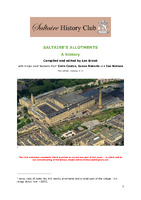 2022.74: Saltaire's Allotments: A history A history of the various allotments in Saltaire researched by Les Brook with major contributions from Colin Coates and James Roberts. A detailed history of the provision and use of allotments in Saltaire, including many changes to their extent and location.
 -
 B1-332: Salts (Saltaire) Ltd Brochure 'Salts (Saltaire) Ltd' Booklet with signature of Mrs Morris. Produced in the year following the listing of Salts (Saltaire) Ltd as a public company. Has brief history of Salts Mill and Saltaire but mainly shows the current operation of the mill. Includes many photographs of the Mill in operation.
 -
 B1-082a,c,d: Salts (Saltaire) Ltd marketing booklet An advertising booklet for Salts (Saltaire) Ltd. Contains text briefly describing the history of the business, but mainly concerning the workings of Salts Mill and the new mill at Uddingston, Scotland at the time of publication. Contains many photographs of mill machinery being used to produce textiles. Also includes photographs of amenities provided by the business including: a hostel for women workers; a clinic; leisure sports facilities in nearby sports grounds and Roberts Park. There is some coverage at the end of the booklet of the new factory at Uddingston.
 -
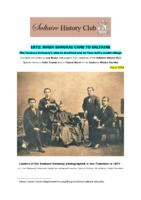 2024.34: 1872: When samurai came to Saltaire A research document from local historian Les Brook on the visit in 1872 of the Japanese Iwakura Embassy visit to Saltaire. The Iwakura Embassy was a high-level governmental group from Japan who toured the world to investigate the latest developments in industry and technology. They visited Saltaire to view the renowned Salts Mill and the model village of Saltaire. Contents include: What was the Iwakura Embassy? The Embassy’s historical backstory The members of the Embassy The Embassy in the USA Four months in Britain The visit to Bradford and Saltaire DAY 1: Thursday 24 October 1872 DAY 2: Friday 25 October 1872 DAY 3: Saturday 26 October 1872 DAY 4: Sunday 27 October 1872 DAY 5: Monday 28 October 1872 From Yorkshire to London The Embassy in continental Europe, and beyond
 -
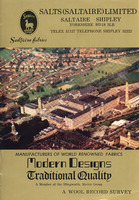 B1-463a-b: Salts (Saltaire) Ltd - A Wool Record Survey A public relations brochure detailing the major modernisation of textile machinery and processes in Salts Mill during the early 1970s. The text describes how the space in the Mill was reorganised to improve efficiency using a 'flow line' principle of production. The entire ground floor of the Mill was restructured. There was large-scale replacement of machinery by up-to-date models. There are photographs of the new machinery, including: 'Scourmatic' large scale scouring machines; 'Volkman' two-for-one twisting machinery; Hattersley and Knowles warping machines and Benninger warping machines; Sulzer weaving equipment; and Mount Hope machines for wet finishing and weft straightening. There are also full-page adverts for some of the equipment suppliers.
 -
 2024.36: Descriptive Index Catalogue of the Library of the Saltaire Club and Institute A full catalogue of the contents of the Library of the Saltaire Club and Institute. Has brief details in the front of the volume of the operation of the LIbrary. Most of the 1665 pages consist of an alphabetical listing of the items held in the Library.
 -
 2026.3: Saltaire: the making of a model town. A critical appraisal of the analysis of the 16 building contracts A 20 page document with text and images of newspaper cuttings. This document critically analyzes the historical building contracts and tender processes involved in the development of Saltaire village, as detailed in Jackson, Lintonbon and Staples' book 'Saltaire: the making of a model town'. A particular issue addressed is that the term 'building contract' is used, both historically and by the book authors, to refer to a range of items, including invitations to tender as well as actual contracts. Another problem considered is that often contracts were advertised for both public buildings and housing but then subsequently separated.
 -
 2024.115.1: Connecting the threads: From Altiplano to Airedale: 1. Introduction One of a set of research documents on the production of alpaca wool in Peru and its subsequent journey to the United Kingdom for use in the textile industry. The Introduction gives information on the sources used, and sets the scene for telling the story of how a few firms in West Yorkshire made a huge imapct in a remote part of Peru.
 -
 B1-032/6/10: Salts Mill : Volume Six : Collection of Christmas Cards from the Directors of Salts (Saltaire) Ltd Painting of Saltaire Congregational Church
 -
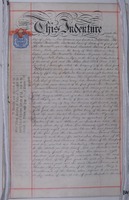 2021.4.3: Original conveyancing document for strip of land near Hirst Mill Original conveyancing document between the Reverend Randall Parsons, the Rt. Hon Lawrence, Earl of Rosse) and Sir Titus Salt Bart, Sons and Co. Ltd. with James and Bertram Roberts for a plot of land at Hirst Mill - 02/07/1900 - The deed relates to a strip of land behind Hirst Mill cottages
 -
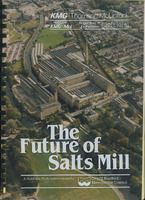 2025.75: The Future of Salts Mill A Feasibility Study by management consultants KMG Thomson McLintock commissioned by City of Bradford Metropolitan Council. The study was commissioned to review the future of the Salts Mill site in 1987. It is a comprehensive study and proposals for redevelopment of the mill. It precedes the purchase of Sats Mill by Jonathan SIlver later in 1987. See also 2025.76 which is the associated appendices to this report.
 -
 2020.22: Photos of William Firth working at Salts Saltaire Limited together with his retirement photos William Firth photos working at Salts Mill 1. Small black and white photograph showing 4 workmen outside the front of Salts Mill, two of whom are named as Albert and Billy Firth 2. Close up black and white photograph of five workmen and the Salts Saltaire Limited lorry. Two men are named as Ernest Sellers and Billy Firth 3. Black and white photograph of the same five workmen standing in front of the Salts Saltaire Limited lorry 4. Black and white photograph of William Firth winching bales of wool in the yard of Salts Mill. On the reverse side the photographer 'J.E. Tate 4 Rhodes Street Shipley Tele. 56736' is listed 5. Black and white photograph of William Firth leaning against a Salts Saltaire Limited lorry 6. Coloured photograph of William Firth leaning against a green Salts Saltaire Limited lorry William Firth 50 years at Salts Mill 7. Black and white photograph of William Firth and his wife at his long service presentation for 50 years service working at Salts. The reverse says 'J. Norman Preston & Co. photographer Bingley 12th May 1972' 8. Black and white photograph of William Firth taken at a presentation at Salts Mill in April 1967. The reverse says 'J. Norman Preston & Co. photographer Bingley 19th April 1967' William Firth, son of Harry Firth, worked for 50 years at Salts Saltaire Limited. Other members of his family also worked at Salts Mill. Albert Firth, his brother, worked for eighteen years at Salts. His sister Nancy worked for fourteen years. William worked in the transport department/yarn warehouse. he drove the salts wagon between Saltaire and Uddingston, Lanarkshire
 -
 B1-032/3: Commentary by Dave Shaw on the photographs of and brochures about Salts Mill machinery from the Bowtell Collection. Commentary by Dave Shaw on the photographs of and brochures about Salts Mill machinery from the Bowtell Collection. 'Photographs exist of some of the machinery installed in Salts Mill during its days of textile production. Several of the photos were used in two promotional brochures produced by the company, the first (in French) in 1918 (approx) under the name Sir Titus Salt Bart Sons & Co Ltd; the second, in 1924 (approx) under the name Salts (Saltaire) Ltd. (Further commentary on the two brochures can be found overpage). Additionally, there are photos of the Mill departments following removal of machinery, presumably taken in the 1980s. The photographs were held by the late Mr Albert Bowtell, and subsequently (2007) donated by his widow Mrs J Bowtell to the Saltaire Archive. The original photos have been digitally scanned to minimise further handling and many are reproduced here for easy reference. We are anxious to document as much as we can about the type of machinery seen in the photos, its date of use, the mill department in which it was used etc etc. If you can help us to this end, please add your comments (together with your name and contact details) to the sheets accompanying the photos. The Industrial Museum has in its Reference Library a few Salts Mill brochures which are a very good source of information. Two of the brochures date from around the 1920s, one being in French, the other being in English. The French-language brochure was designed and printed by W. N. Sharpe Ltd., of Bradford and London. The Mill's company name in the brochure is 'Sir Titus Salt Bart Sons & Co Ltd'. Its text has mention of a Royal visit in 1918, so it dates from after that event. I currently judge it to be 1920-ish. (Also it is judged to have been produced by letterpress (indicated by the imprint on p15/16). The English language brochure was designed and printed by Percy Lund, Humphries and Company Ltd, The County Press Ltd, Bradford. The Mill's company name in the brochure is 'Salts (Saltaire) Ltd'. The brochure carries a page of photos of the company's board members of 1924, which presumably allows us to date it as being of that year. (This brochure is thought to have been produced by litho-press). Much of the text and the illustrations are common to the two public ations. The French-language text is briefer than the English-language text, and the English-language brochure has more illustrations. Although most of the illustrations are common, many of those of the English-language brochure have been 'improved' — eg blemishes in photos have been removed; indistinct features have been sharpened by hand etc. Even the Belwarp and alpaca trademarks of the two public ations are not quite identical. An illustration of the Mill, viewed from the SW, is common to both brochures but with modifications having been made in the later one — for example, cars have replaced horse-drawn carts seen in the other (earlier) brochure. What is also of interest is that several — perhaps the majority — of the photos are the same as those in Mr Bowtell's collection, including the ones which have been touched up. As we investigate the various photos in more detail, the two brochures will help date the textile machinery that features in the photos in the collection of Mr Bowtell.'
 -
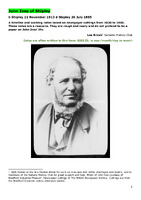 2026.1: John Ives timeline and notes A 78 page document with notes, newspaper exceprts and some excerpts from plans and maps all relating to the life and activities of John Ives. John Ives was a major builder during the mid to late nineteenth century in Bradford and surrounding areas. He built Bradford's new town hall, and many buildings in Saltaire.
 -
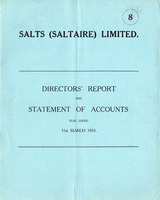 B1-094: Salts (Saltaire) Ltd Directors Report and Statement of Accounts : 31st March 1931 Salts (Saltaire) Ltd Directors Report and Statement of Accounts : 31st March 1931
Catalogue data (excluding media) available under Creative Commons Attribution-ShareAlike (CC BY-SA 4.0) licence.
1–20 of 2452