Items
Search full-text
salts mill
-
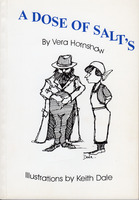 2022.33: A Dose of Salts by Vera Hornshaw The autobiography of a nurse at Salts Hospital
 -
 E1b-031a: Boys from Salts High School Photograph of the 1909 Oxford senior team from Salts Boys Boys High School
 -
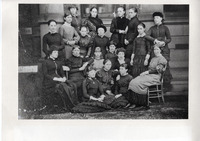 E1b-065a: Girl students at Salts High School Print of copy of photograph of girls at Salts High School c.1880s
 -
 Dayton Coal and Iron Company Limited Company founded in Dayton, Tennessee, United States owned by the Salts company. The company manufactured iron and stell, based on the large local deposits of iron ore and coal. The Salts made major investements in the company which were partly to blame for the subsequent financial difficulties of the textile business in the UK. The Salts gave up their interest in the Dayton company in 1892 and sold the textile business the following year. Dayton was the site of rich coal and iron deposits. Its original developers obtained a loan from Sir TItus Salt Bart. and Sons Ltd, but they went bankrupt. The directors of the Salts company, including Titus Salt Junior, took over the Dayton firm and made large investments to develope the site. They built: two large blast furnaces with a capacity of 250 tons of iron ore per day, three fire brick kilns and 200 coke ovens were constructed as well as 200 homes, a manager's house (costing $15,000), a company store, a schoolhouse and other social amenities. What had been a small hamlet grew into a sizeable town over a very short period. In 1892 the Salt business partners had to surrender their interests in Dayton due to the collapse of Sir Titus Salt (Bart) Sons and Co. Ltd. The investment the company had made in Dayton was a significant factor in the Salt family’s loss of their business and the estate of Saltaire.
 -
 2019.59: Textile Voices: a century of mill life A book by Tim Smith and Olive Howarth of Bradford Heritage Recording Unit. Contains reminiscences of textiles workers about working in mills around Bradford, as recorded by the Unit. Illustrated with photographs of mills, workers and the streets of Bradford and nearby towns
 -
 C3a-075a: An account of life in Saltaire: 1894 onwards An account of life in Saltaire 1894 onwards by Clara Barraclough [nee Knott]. Associated with a photograph of the Yorkshire Amateur Swimming Association in 1961 [C3a-075c], Shipley Swimming Team [C3a-075] and a note about Martha Knott.
 -
 2024.115.2: Connecting the threads: From Altiplano to Airedale: 2. Life on the Altiplano One of a set of research documents on the production of alpaca wool in Peru and its subsequent journey to the United Kingdom for use in the textile industry. Part two details the farming of alpacas for their wool in the Altiplano region of Peru. The focus is on the relations of production and the roles taken on by various groups in the process.
 -
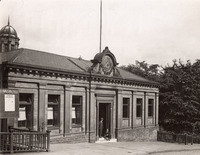 Dining Hall building, Saltaire, West Yorkshire, United Kingdom The Dining Hall was the very first public building in Saltaire, completed in 1854. The Dining Hall served many purposes during the early years of Saltaire. In addition to serving 600 breakfasts and 700 dinners every day, it doubled as a school for ‘half-timers’, children who would work in the mill during the morning, then attend school in the afternoon. It also served as a meeting hall, library, reading room and a venue for religious services, public lectures and other meetings. As Saltaire grew, these functions were gradually moved to purpose-built buildings including: the Salt Schools on Victoria Road, the Saltaire Club and Institute, the Congregational Church and the Methodist Chapel. Today, the Dining Hall is owned by Shipley College and is known as the Mill Building. A major refurbishment and conversion in 1998 modified the interior to make it suitable for lessons, but the changes are entirely reversible.
Catalogue data (excluding media) available under Creative Commons Attribution-ShareAlike (CC BY-SA 4.0) licence.