
Items
Search full-text
united reformed church
-
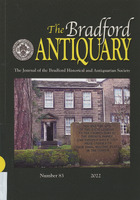 2025.32: The Bradford Antiquary 2022 The Bradford Antiquary The Journal of the Bradford Historical and Antiquarian Society Issue number 83-2022 Contains chapter entitled 'Bradford Free Libraries 1872-1967' by Bob Duckett p.43-61
 -
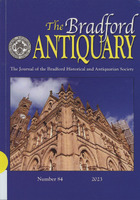 2025.33: The Bradford Antiquary 2023 The Bradford Antiquary The Journal of the Bradford Historical and Antiquarian Society Issue number 84-2023 Contains chapter entitled 'Bradford's Wool Barons and the abiding allure of land' by Stephen Whitehead' p 12-22 which mentions both Titus Salt and James Roberts
 -
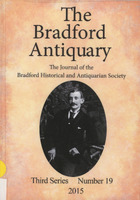 2025.34: The Bradford Antiquary 2015 The Bradford Antiquary The Journal of the Bradford Historical and Antiquarian Society Third Series number 19-2015 Contains chapter entitled 'Singing in the Rain : Saltaire Prize Choir 1896' by James Ogden p.61
 -
 2025.4: The Bradford Antiquary April 1958 The Bradford Antiquary The Journal of the Bradford Historical and Antiquarian Society New Series Part 39 April 1958, includes illustrations
 -
 2025.5: The Bradford Antiquary December 1962 The Bradford Antiquary The Journal of the Bradford Historical and Antiquarian Society New Series Part 41 December 1962, includes illustrations
 -
 2025.6: The Bradford Antiquary November 1964 The Bradford Antiquary The Journal of the Bradford Historical and Antiquarian Society New Series Part 42 November 1964, includes illustrations
 -
 2025.7: The Bradford Antiquary July 1969 The Bradford Antiquary The Journal of the Bradford Historical and Antiquarian Society New Series Part 44 July 1969, includes illustrations
 -
 2025.8: West Yorkshire: A noble scene of industry Subtitled: The development of the county 1500 to 1830. The book is a synopsis of the results of a survey by West Yorkshire County Council of the economic and social development of West Yorkshire, after 1500 AD. Contains chapters on: Textiles; Iron and coal; Minor industries; Communications; Working-class housing; Prioriries for future work. Includes maps of industrial activities, plans of buildings, photographs and other illustrations.
 -
 2025.9: The Bradford Antiquary October 1982 The Bradford Antiquary The Journal of the Bradford Historical and Antiquarian Society New Series Part 47 October 1982, includes illustrations and a loose copy of the 104th Annual Report 1982. D G Wright's Mid-Victorian Bradford : 1850-1880 mentions Titus Salt and Saltaire.
 -
 E1a-087: School Bell Scholl handbell - Brass bell with wooden handle
 -
E1a-088: School Slate School slate
-
 Edward VII, King Edward was king of the United Kingdom between 1901 and 1910. As the Prince of Wales, he visited Yorkshire in 1882 with his wife Princess Alexandra to preside at the opening of the new Technical College in Bradford. While visiting, the prince and princess stayed at Milner Field, the home of Titus Junior and Catherine Salt.
 -
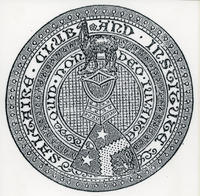 Saltaire Club and Institute The Saltaire Club and Institute opened in 1870 and was based in a large new building on Victoria Road, above Salts Mill. The building is now referred to as Victoria Hall. Although not part of the temperance movement, Titus Salt was staunchly opposed to the construction of a public house in his village, having seen many workers in Bradford drink their wages away as soon as they were paid and fail to provide for their families. Residents were free to drink at home or at pubs outside the village but Salt hoped they would be attracted by the more immediate Social Club and Institute. The founding rules of the Club and Institute stated that its objects were 'to afford to the inhabitants of Saltaire, and its neighbourhood, the means of social intercourse, mutual help, mental and moral improvement and rational recreation, also to afford facilities for holding meetings of Friendly and other Societies'. There was a small quarterly charge for membership, whch was open to men, women and young people over the age of 13. The building housed rooms for billiards, bagatelle, chess and drafts, reading, classrooms, an extensive library, a laboratory and a large hall for lectures and concerts. In the 1880s it housed the Schools of Art and Science before they moved to the purpose-built Exhibition Building.
 -
 Salt, Titus, Junior Fifth son of Sir Titus and Caroline Salt. He became one of the leading directors of the family firm Sir Titus Salt, Bart. and Sons Ltd.
 -
 Dayton Coal and Iron Company Limited Company founded in Dayton, Tennessee, United States owned by the Salts company. The company manufactured iron and stell, based on the large local deposits of iron ore and coal. The Salts made major investements in the company which were partly to blame for the subsequent financial difficulties of the textile business in the UK. The Salts gave up their interest in the Dayton company in 1892 and sold the textile business the following year. Dayton was the site of rich coal and iron deposits. Its original developers obtained a loan from Sir TItus Salt Bart. and Sons Ltd, but they went bankrupt. The directors of the Salts company, including Titus Salt Junior, took over the Dayton firm and made large investments to develope the site. They built: two large blast furnaces with a capacity of 250 tons of iron ore per day, three fire brick kilns and 200 coke ovens were constructed as well as 200 homes, a manager's house (costing $15,000), a company store, a schoolhouse and other social amenities. What had been a small hamlet grew into a sizeable town over a very short period. In 1892 the Salt business partners had to surrender their interests in Dayton due to the collapse of Sir Titus Salt (Bart) Sons and Co. Ltd. The investment the company had made in Dayton was a significant factor in the Salt family’s loss of their business and the estate of Saltaire.
 -
 Hanson, William Head of the engineering department at Salts Mill during the nineteenth century. Great Grandfather of Donald Hanson, the chair and chief executive of Illingworth, Morris the last owners of Salts Mill as a textiles business in the 1980s.
 -
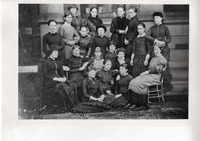 Salt High School The Salt High School opened in 1876. Initially it occupied temporary accommodation, mainly in the Saltaire Club and Institute. In 1878 it moved into the building on Victoria Road that had originally been built to house the Factory School for Salts Mill. The High School was open to both boys and girls although they were educated separately. The High School eventually moved to a new site on the far side of Roberts Park. Today the original buildingis part of Shipley College, a further education institution.
 -
 Salt, Catherine Catherine was born in 1846 into one family of textile magnates, the Crossleys of Halifax, and married into another when Titus Salt Junior became her husband in 1866. In some ways Catherine was quite conventional, raising four children and running her privileged Victorian household, including hosting the Prince of Wales and later his sister Princess Beatrice at her home. But Catherine clearly had deep and wide interests in social and educational issues, particularly the education of girls. She helped found Bradford Girls Grammar School and served for many years on its board, and also the board of the Salt Schools.
Catalogue data (excluding media) available under Creative Commons Attribution-ShareAlike (CC BY-SA 4.0) licence.
1821–1840 of 5131