
Everyday histories of women
In this exhibition we highlight the ‘Everyday Histories’ of women, connected with Saltaire, whose stories challenge the expectations of their times.
Some of these women are remarkable not just for what they achieved, or the fields in which these achievements occurred, but for succeeding in a predominantly male-dominated society.
Others’ lives are quieter, more ordinary but are still worthy of recognition and demonstrate the resilience of women and their hunger for self-determination.
Women of today have much to thank their predecessors for and yet many of these lives are hidden in boxes in archives up and down the country. Here we unpack some of these boxes and showcase these admirable women, some of whose stories we tell for the first time.
Caroline Maria Lupton (Marie Studholme) 1872-1930: Actress and postcard beauty
Born in Eccleshill and raised in Baildon and Shipley, Maria attended Salt Girls’ High School before joining her mother in London at the age of 15 years.
Having changed her name to Marie Studholme and needing a source of income, she joined the chorus of La Cigale at the Lyric Theatre and her long, successful career in musical theatre begun. She played leading and support roles in productions in London, across the country and in the USA.
In 1914 she returned briefly to Bradford to perform at the newly opened Alhambra music-hall. Cheering crowds surrounded the theatre, keen to see the star in her hometown.
Marie was a renowned beauty and this made her one of the most popular postcard models of her time. But this also brought her trouble, as she was constantly pursued by devoted anonymous admirers. Occasionally, her image was falsely used in advertising campaigns.
Marie died in 1930 after an attack of rheumatic fever. She left an estate of £58,303, (approximately £49.5 million in 2026).
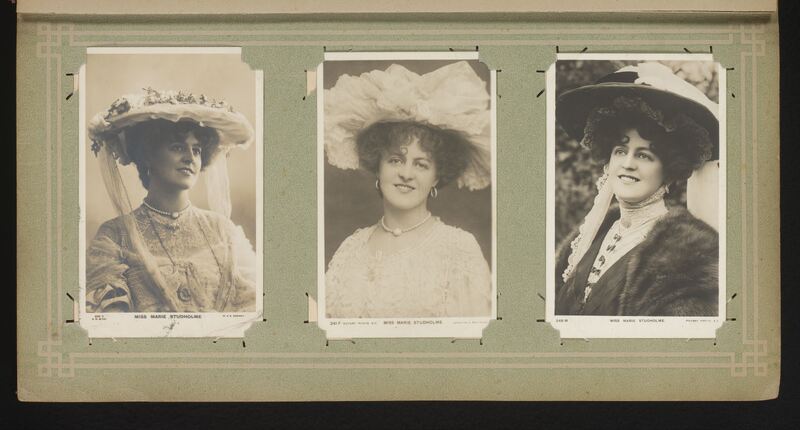
Postcard portraits of Maria Studholme. Courtesy of Rijksmuseum, Amsterdam, CC0, via Wikimedia Commons
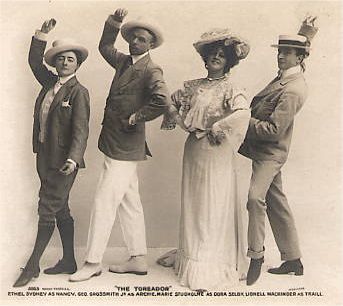
Advertising poster for 'The Toreador' 1903, featuring Marie Studholme and other actors. Courtesy of Wikimedia Commons
Medina Griffiths and Harriet Byles: Progressive headteachers
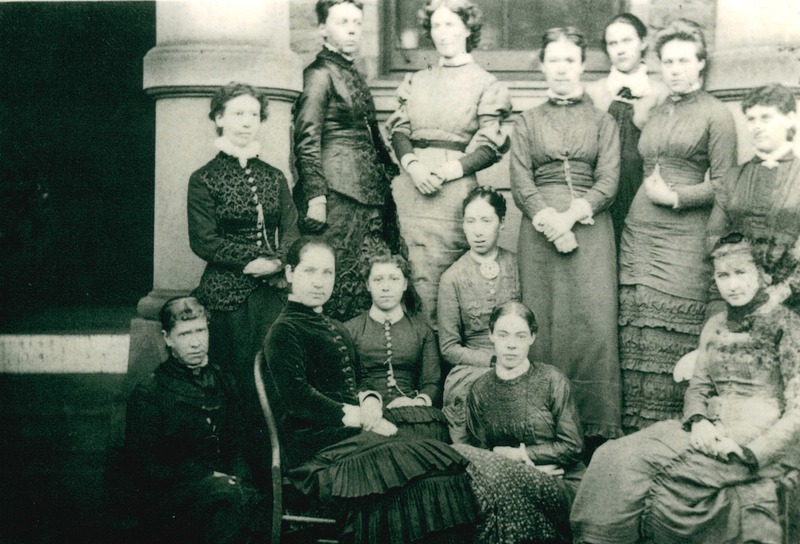
Staff of Salt Girls High School about 1880. Medina is stood on the back row, extreme left. Harriet is seated in the centre of the middle row
Medina Griffiths and Harriet Byles were pioneering headmistresses of Salt Girls' High School.
Appointed in 1876 as the school's first headmistress, Medina was an inspirational educator who advocated for equal educational opportunities for girls, introducing a broad curriculum that included classics, modern languages, sciences, and the arts while encouraging university study.
Succeeding her in 1886, Harriet became the school's longest-serving headmistress, leading for 34 years. She expanded the school's facilities and secured scholarships for students from poorer backgrounds, fostering an inclusive, supportive environment that helped many young women progress to higher education and distinguished careers.
Annie Lund 1874-1950: Teacher
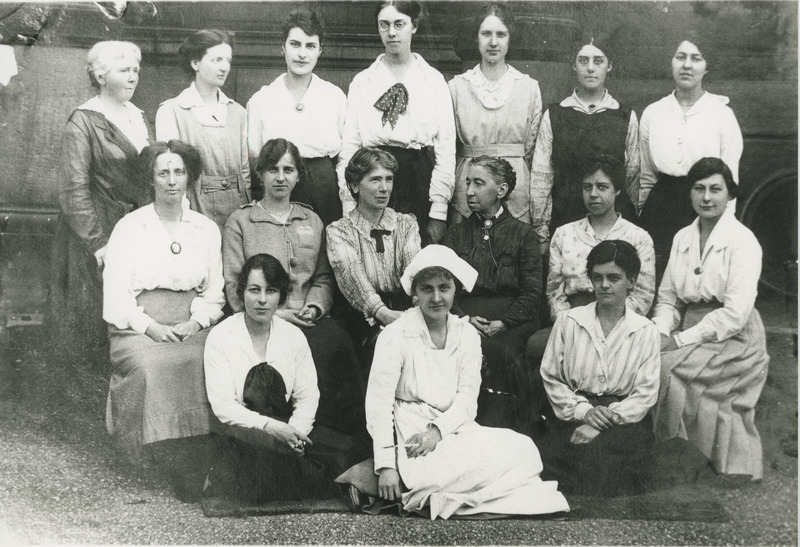
Staff of Girl High School in early 20th century. Annie is seated third from the left in the middle row
Possibly the most significant event in Annie Lund’s life was the death of her father, a farmer in Brafferton, North Yorkshire, in a shooting accident in 1879 when she was five.
This sudden bereavement brought the Lund family of at least seven children to Manningham in Bradford. Annie was the youngest daughter but one. In 1886 she was sent to the Salt Girls' High School, a fee-paying school. She moved from being a pupil to being a teacher in 1893.
It was a solid career with a salary starting at £90 a year rising by many increments to £315 a year. in 1921, amply repaying the money her family spent on her education.
She retired in 1933 and died in 1950, leaving £7,800 (about £240,000 in 2026)
Sarah Anne Walker 1870-1950: Pioneering educator
Sarah’s career began at Salt Girls' High School, where she was both a pupil and a teacher. Her academic success led to a scholarship at the Maria Grey Training College followed by a distinguished career at Southlands College, becoming Vice Principal.
Sarah later went on to become Principal of Darlington Training College championing Frobelian and Montessori teaching. She opended one of the first open air nursery schools in the country.
Sarah advocated improved teacher training, nursery education and the advancement of women both through her work and membership of local and national organisations. Her legacy continues today via student scholarships and grants.
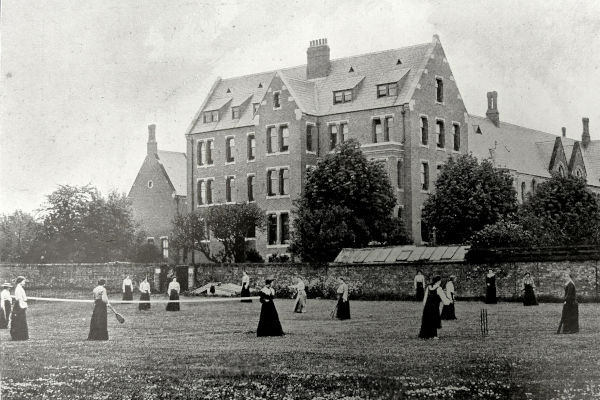
Darlington College in early twentieth century, where Sarah was principal
Lois Bates 1855-1932: Educator and author
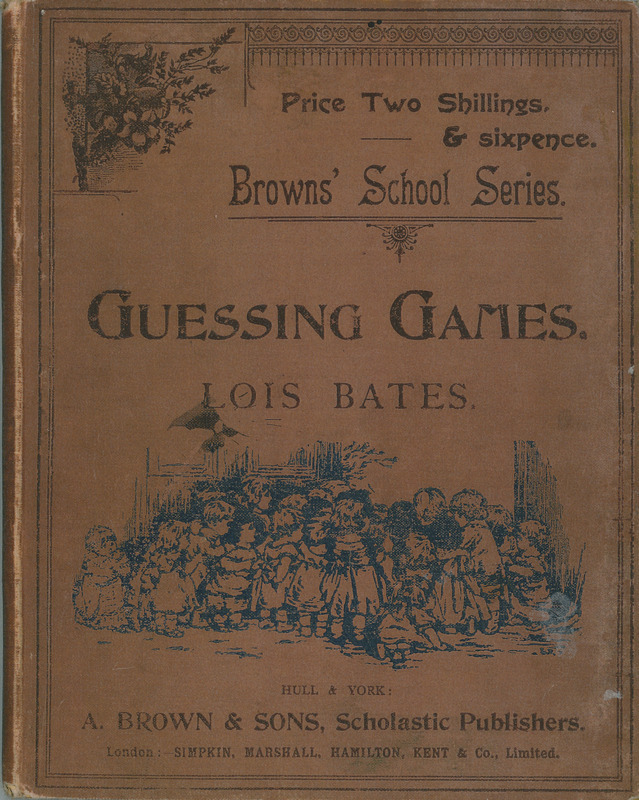
Front cover of Lois Bates's book 'Guessing Games'
Lois Bates grew up in a large family in Almondbury, Huddersfield, before beginning a career that would shape early years education in Saltaire and beyond. In 1879 she was appointed Mistress of Albert Road Infant School, remaining there for more than fifteen years.
Her influential books - 'Saltaire Action Songs' and 'Guessing Games' - helped popularise her Froebelian education methods, many of which were adopted by the Education Department. Children under seven experienced a less formal style of teaching, learning social skills and manners through stories, songs and play.
Although she had to give up her teaching career when she married in 1895 , Lois continued to write, producing further works including her 'Kindergarten Guide', now recognised as an important contribution in the history of early-years education.
Hilda Byles: Courageous medical missionary
Hilda attended Salt Girls' High School before studying at the London School of Medicine for Women.
In 1907 she sailed to China to lead the London Missionary Society Hospital in Hankow, quickly gaining a working knowledge of Chinese and the respect of the local population.
For 24 years she worked tirelessly in difficult conditions helping others including the destitute, lepers, and girls trapped in prostitution, often risking her own safety.
Hilda died of pneumonia in Hankow in 1931. Described in her obituary as 'a little woman of amazing energy and capabilities', mourners from three cities gathered at her funeral to honour a woman they greatly loved.
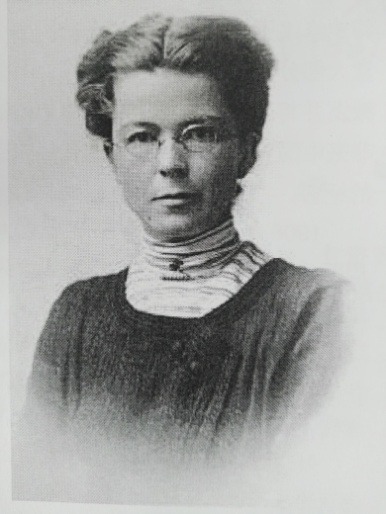
Hilda Byles in the early 20th century
Ethel Magill 1881-1970: Pioneering radiologist
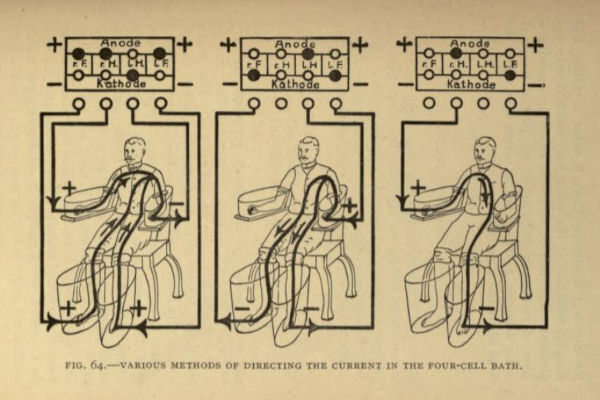
Diagram showing use of Four-cell bath from Magill's book 'Notes on Galvanism and Faradism'. Image courtesy of Internet Archive
Ethel May Magill was a pioneering British physician and radiologist who graduated from the London Medical School for Women in 1906. During World War I, she served as a consultant radiologist at Endell Street Military Hospital, where she specialized in locating shrapnel and developing early physiotherapy techniques.
Magill authored an influential textbook on electrotherapy and received an OBE in 1920 for her wartime service. Her career spanned clinical work in North America and Africa before she retired to Kent. She remained an active member of the medical community until her death in 1970.
Hannah Mitchell 1868-1936: Matron extraordinaire
Hannah Mitchell was appointed Matron of Sir Titus Salt’s Hospital in 1899. She had trained at Kings College Hospital, London and worked at Bradford Royal Infirmary.
Her 'job description' covered not just medical matters but all aspects of the hospital’s operation and management including fund raising.
Hannah was an extremely competent, ambitious and progressive woman, a strong advocate of women’s rights as evidenced by her numerous letters in the local press. She was a committed Catholic and for many years, president of the local branch of the Catholic Women’s League.
During World War One the hospital was designated a War Hospital. Hannah was extremely popular with the convalescent soldiers, raising money and organising activities for their entertainment. As with all women at that time, on her marriage in 1918 Hannah had to leave her job. Having stated she didn’t want any gifts the soldiers clubbed together and bought her a case of silver spoons.
She died in 1936. In her will she left £10 (approximately £900 today) to the hospital
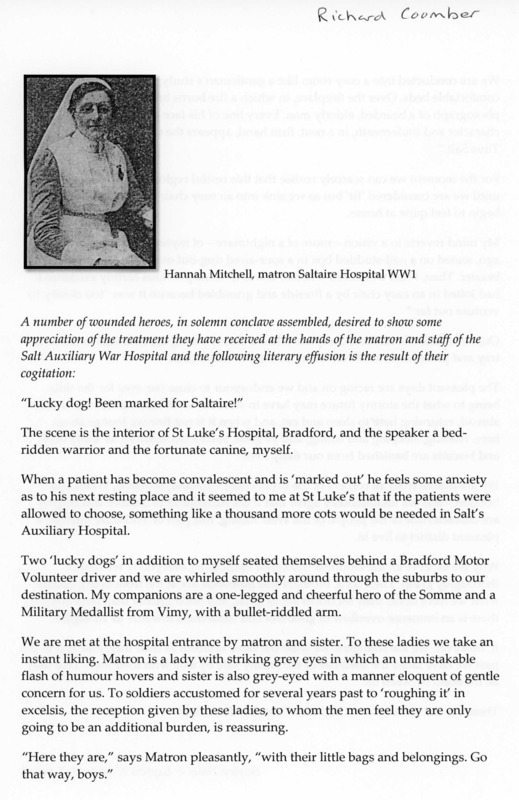
Excerpt from Shipley Times and Express on Hannah Mitchel and the hospital in the First World War
Edna Mary Gunnell OBE 1879–1963: Gardener extraordinaire
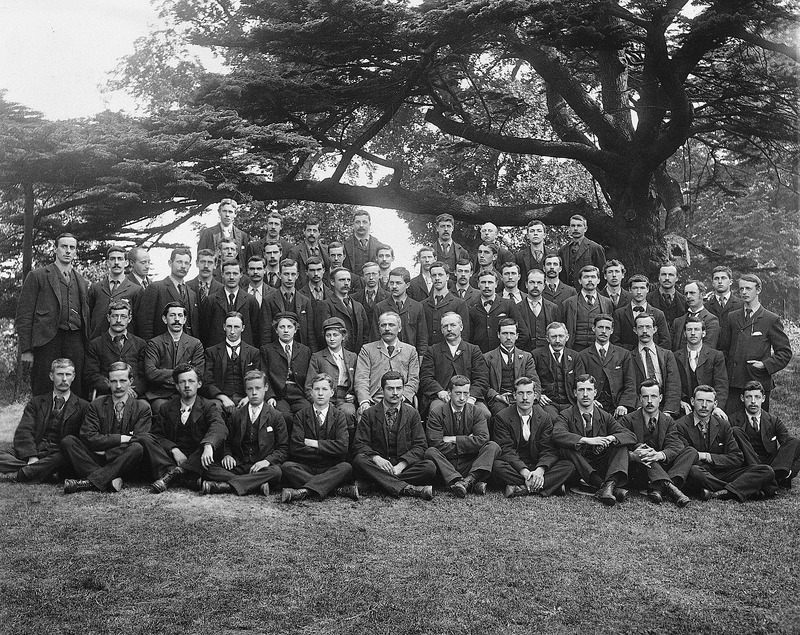
Group photograph of staff gardeners at Kew 1901. Edna is the fourth person from the left on the second row up. Courtesy of Royal Botanic Gardens, Kew
Edna Gunnell was a trailblazer in the world of horticultural education for women.
Graduating from Salt Girls’ High School, she attended University College Reading obtaining a Certificate in Horticulture in 1900. One of only a few women to be trained at the Royal Botanic Gardens, Kew she subsequently held various teaching posts in England, Silesia, Germany and USA.
In 1920 she joined Devon County Council as a Horticultural Superintendent, the first woman to hold the post and, as part of her role, gave lectures and demonstrations to Women’s Institutes and to schools.
At first her lecturers focussed on growing, garden maintenance and pest control but during World War 2 the emphasis changed to fruit growing and food preservation: bottling, jam making, pickles and chutneys. In 1945 she received an OBE in recognition of this work.
Laura Hunter née Thorpe MSc. 1897-1968: Pest expert
Born in Baildon in 1897, Laura Thorpe studied at Salt Girls’ High School before graduating from Liverpool University.
She lectured in both Zoology and Biology at the University of North Wales, Bangor and later at the Leicester College of Domestic Science.
After gaining the Annie Edison Memorial Scholarship Laura wrote Domestic Pests: What They Are, How To Remove Them, a manual that appealed to both housewives and scientists by offering solutions to everyday problems such as how to get rid of insects, rodents and mould.
During the Second World War she focused on public health and nutrition. Her clear, practical advice remains relevant today.
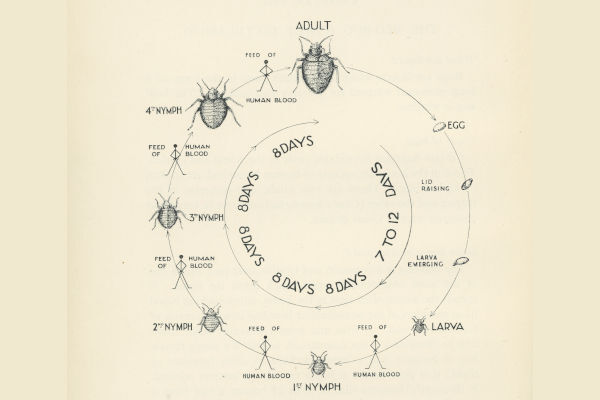
Lifecycle of a bed bug from Hunter's book 'Domestic Pests'
Ivy Muschamp (née Severs) 1918-1982: Helping others
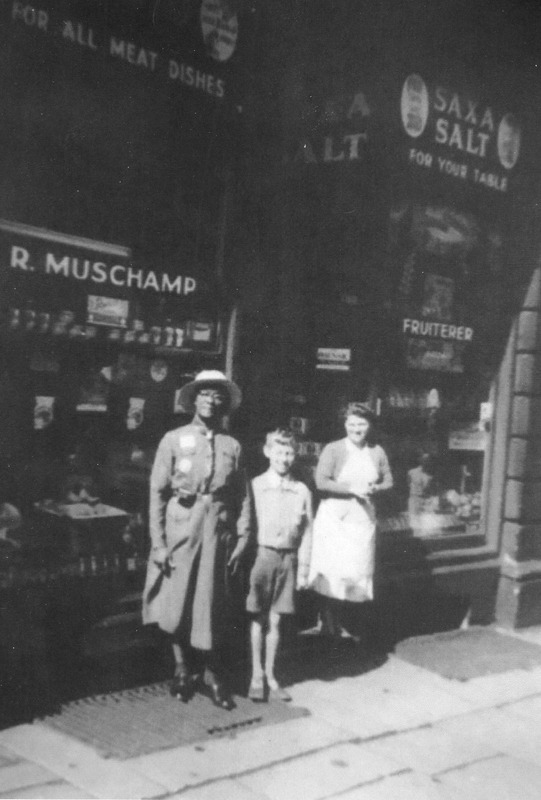
Ivy Muschamp, her son and their visitor Hyacinth from Jamaica outside the shop on Victoria Road
Born in 1918, Ivy was the youngest of four children. She attended Salts Girls’ High School and later became an invoice clerk for a local gown manufacturer, also volunteering as a factory first aider.
Ivy went on to run a grocer’s shop with her husband on Victoria Road, Saltaire, while raising four children.
Ivy was an active member of Bethel Baptist Church - performing in, organising and hosting groups. In 1957 she offered accommodation to a member of the Jamaican delegation visiting the World Scout Jamboree.
Ivy’s story, like that of many women, is a quiet one but shows how her commitment to helping others plays an important part of community life.
The Shuttleworth women 1873-1951: A Saltaire story
Sisters Anne, Sabina and Polly were three of seven children born to George and Ann Shuttleworth. George died in 1899 and the girls remained living with their mother at Albert Road in Saltaire.
Anne was a silk spinner and bowler and later a burler and mender in Salts Mill.
Sabina also worked in Salts Mill until she married in 1900, when she became a confectioner's baker.
Polly was a spinner and weaver in the Mill. In 1922 she emigrated to America.
They were hard working and proud Saltaire women.
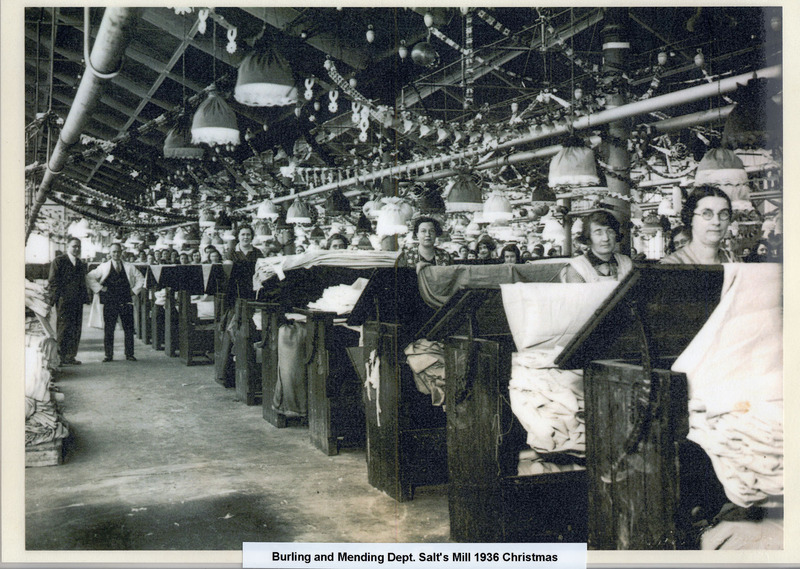
Burling and Mending department at Salts Mill in 1936
Emily Tennant 1887-1974: A long-serving lass
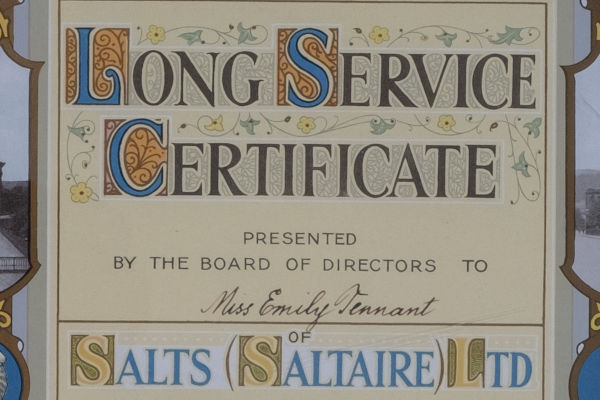
Feature from the long-service certificate for Emily Tennant awarded in 1951 for 50 years service
Emily was born in Baildon to James Tennant and Elizabeth Willis.
Emily began work in Saltaire Mill in Octber 1901 aged just 14. She worked in the spinning department until 1936 and then as a cleaner for a further 25 years in the engine room and later in the yarn office.
In 1953 Emily received a Long Service Certificate from Salts (Saltaire) Ltd in recognition of her 50 years service at Salts Mill.
From 1911 Emily lived with her parents and sister in Shipley and died in 1974 aged 87 and was buried in Nab Wood Cemetery, Shipley.
Ruby Sayner 1897-1973: War work and wickets
Born in 1897, Ruby was one of nine children living in Titus Street, Saltaire. She left school at thirteen to work at Henry Mason’s Mill in Shipley.
During the First World War she was one of only two people from Shipley to join the Women’s Land Army. She trained at Esholt Hall before working on farms nationwide to support Britain’s food supply. She served again in the Second World War, working night shifts as an Air raid (A.R.P.) Warden before returning to her job as a weft clerk.
Ruby’s passion for cricket saw her playing for Saltaire and Blythwick Ladies. She was coached by England bowler Sidney Barnes and represented Yorkshire at Headingley and Bradford Park Avenue.'
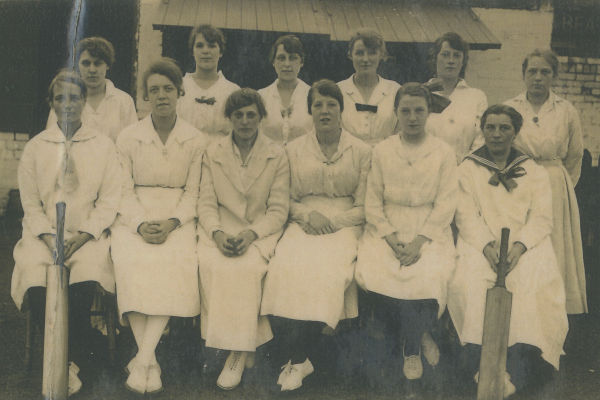
Carrie Pickles 1904-1984: champion Olympic gymnast
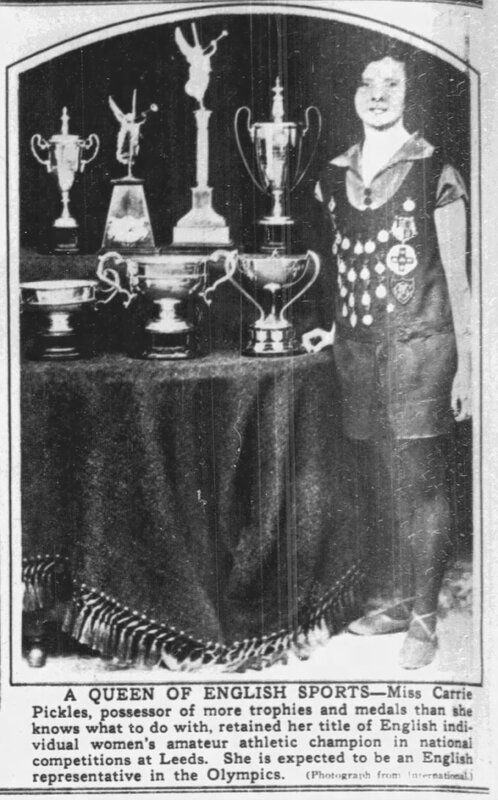
Carrie with some her trophies in 1928. Image credit: International News Service, Public domain, via Wikimedia Commons
For the first time, in 1928, women were taking part in the gymnastics section of the Olympic games. A young woman from Shipley, Carrie Pickles, was among those chosen, not because of any special gym education at school, but because she had joined the Bradford Gymnastics Club in 1919 and worked hard to gain Yorkshire and British championships.
The Olympic team competed with five other women’s teams and gained a bronze medal. They could not afford to stay on for an extra day to receive it, so it was sent after them.
Carrie then retired and moved to teaching and coaching within the community, chiefly at the Saltaire Ladies’ Gymnastic Club. She trained other champions, including her own daughter, Lilian.
You may also be interested in
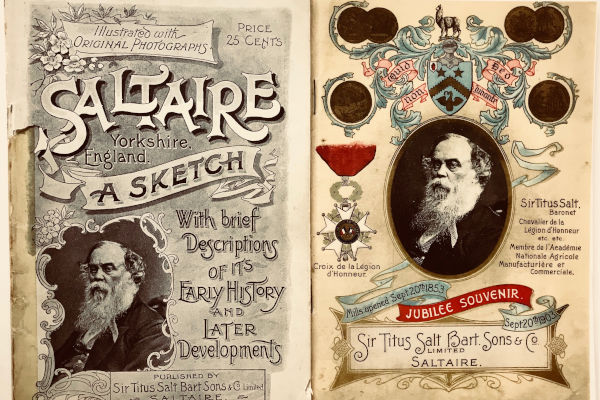

Browse the stories of some of the people who lived in Saltaire, worked in Salts Mill, and travelled from afar to start a new life in the village
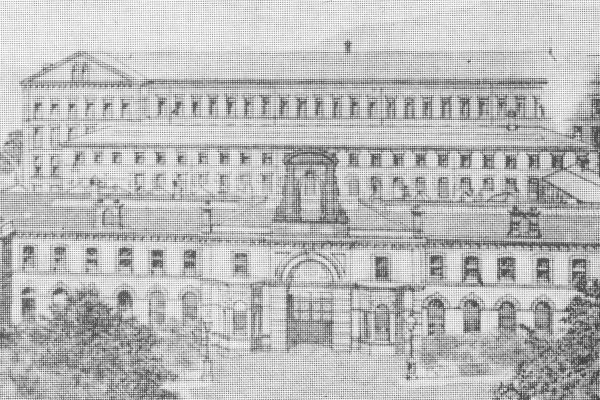
Discover some of the history of Saltaire by listening to our sample of audio stories