
C2a-141b: Drawing out the Threads Interview: Frank Senior
Item
- Identifier
- C2a-141b
- Title
- Drawing out the Threads Interview: Frank Senior
- Type
- video
- Format
- video recording
- Date Created
- 2013
- Creator
- Harrison, Annie
- Description
-
One of a collection of 9 DVD discs with interviews by Annie Harrison for her project 'Drawing out the Threads'. This disc contains interviews with former Salts Mill employee Frank Senior.
Frank’s account provides a detailed look at the layout and operations of Salts Mill, situated between the railway and the Leeds and Liverpool Canal. He recalls that canal barges delivered coal which was shifted manually; two men would shovel '40 tons of coal' in a single day, wheeling it up planks into a storage cellar. The mill itself was a massive, subdivided building containing departments for wool scouring, combing, drawing, spinning, weaving, and finishing. - Associated person or organisation
- Senior, Frank
- Associated place or event
-
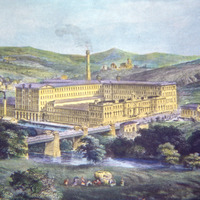 Salts Mill, Saltaire, West Yorkshire, United Kingdom
- Source
- Harrison, Annie
- Rights
- Only viewable in the Saltaire Collection
- Rights Holder
- Copyright Annie Harrison
- Abstract
-
Early in his career, Frank worked in a long, narrow office that the interviewer likens to a 'Dickensian' or 'Scrooge-style' setting due to Frank and his boss working on high stools, using 'inkwells and pens' - specifically a 'toboggan nib' with a hump on its back - while performing all calculations longhand on scraps of paper kept on a desk spike. Communications were initially handled by phone, with workers taking down 'coded messages' (often from 'Gong' (Gungahlin?) Australia) in longhand to keep business secrets from competitors. Frank later modernised this process by introducing a 'Telex (TX) machine'.
The mill's working conditions were often extreme:
-Temperature: The top-floor spinning room, known as the 'lobby', had a glass roof and could reach temperatures over 100 degrees Fahrenheit in the summer.
-Winter: The heating system dated back to the 1850s, and it often took until Thursday morning for the temperature to reach 60 degrees; workers frequently wore 'overcoats' while the expanding steam pipes made loud 'explosions'.
-Sandblasting: In the 1950s, the building was sandblasted to remove soot, forcing employees to breathe in sand for a month while they continued to work.
Frank details the 'scientific complexity' of textile production, explaining yarn counting and the 'Bradford set'. This formula involved adding a ninth to a set (e.g., a 48 set became 54 ends per inch) as a way to 'camouflage' manufacturing specifications from rival companies. Following the war, the mill's administration expanded significantly with new cost-control departments. This led the Managing Director, 'RW Guild', to ask Frank to act as a confidential whistleblower by writing a report explaining what all the new staff members actually did.
- Persistent address
- https://explore.saltairecollection.org/s/p/item/16881
- Item sets
- Saltaire Collection
Export
Catalogue data (excluding media) available under Creative Commons Attribution-ShareAlike (CC BY-SA 4.0) licence.