
C2a-141d: Drawing out the Threads Interview: Val Wooley
Item
- Identifier
- C2a-141d
- Title
- Drawing out the Threads Interview: Val Wooley
- Type
- video
- Format
- video recording
- Date Created
- 2013
- Creator
- Harrison, Annie
- Description
-
One of a collection of 9 DVD discs with interviews by Annie Harrison for her project 'Drawing out the Threads'. This disc contains interviews with former Saltaire resident Val Wooley.
The interview provides a detailed look at life in Saltaire, focusing on the intersection of work, domestic life, and social activities centered around Salt’s Mill. - Associated person or organisation
- Wooley, Val
- Associated place or event
-
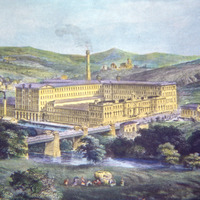 Salts Mill, Saltaire, West Yorkshire, United Kingdom
- Source
- Harrison, Annie
- Rights
- Only viewable in the Saltaire Collection
- Rights Holder
- Copyright Annie Harrison
- Abstract
-
Social Life and Perks
The interviewee recalls her youth wearing clogs and attending St. John’s Ambulance meetings held in a large hall above the mill canteen. A significant perk of earning a St. John's uniform was the ability to serve as a first aider at the Gaumont cinema, which granted free entry to films like Rock Around the Clock. While she never witnessed anyone fainting, the uniform allowed her to sit at the back and watch dozens of films for free.
Housing and Domestic Conditions
Families often lived in compact but well-built houses on streets like Duff Street. The interviewee notes that these homes were crowded; her husband Brian's family had five daughters and two parents sharing only three bedrooms. Until indoor toilets were fitted later, residents used outside toilets in the yard. Home life revolved around a cast-iron stove and fireplace. To save money on expensive coal or coke, families used 'fire bricks' to retain heat and were extremely diligent about counting coal sacks to ensure they weren't cheated by the coalman.
The Mill Environment and Hierarchy
The mill was the primary employer, and having many daughters was considered an advantage for securing housing because they could all work in the mill. The interviewee describes the 'winding room' as having a terrible and constant 'boom' of noise. Her mother even lost the top of a finger in a machine accident there.
A clear social hierarchy existed between 'staff' and 'workers'. While staff might have access to jugs of water, workers in the canteen were reportedly denied glasses of water. These workers were responsible for washing their own plates and cutlery in a large sink using a great big brush. On paydays (Thursdays), it was common for families to enjoy small treats like sugared almonds, sweets, or Woodbine cigarettes.
Community Customs and Holidays
-Grooming and Resourcefulness: Women often wore 'wound-round' aprons and used discarded wood or cardboard cones from the mill for lighting fires or as hair curlers under their turbans.
-Mischief Night: On November 4th, children would play a prank by tying the doorknobs of entire streets together with clotheslines and then knocking on the doors.
-Holidays: Whitsuntide was a major event where everyone wore new dresses and traveled across the bridge to 'Shipley Glen'. This 'resort' area featured a fairground with boat swings, a tramway, and early 'bright green' ice lollies.
Tragedy at the Bridge
A sombre memory involves a fatal accident where a truck carrying wool bales crashed off the bridge into the water. Val's husband, Brian, attempted to rescue the driver, resulting in permanent stretch marks on his back. The man died, and the annual mill dance was cancelled as a result.
- Persistent address
- https://explore.saltairecollection.org/s/p/item/16882
- Item sets
- Saltaire Collection
Export
Catalogue data (excluding media) available under Creative Commons Attribution-ShareAlike (CC BY-SA 4.0) licence.